
Marthinusen & Coutts (M&C) have recently made significant advances in developing advanced diagnostic tools for rotating machines, most notably the Stray Flux Analyser and Salient Pole Rotor Simulation tools. These innovations are not only setting new standards for efficiency and accuracy but are also transforming the way engineers and operators approach condition monitoring and fault analysis.
The Inspiration Behind the New Tools
The development of the Stray Flux Analyser and Salient Pole Rotor Simulation tools was driven by evolving industry demands. According to the M&C team, the increased utilisation of flux-probing techniques and the rising number of machines fitted with permanent probes provided a clear motivation. The main objectives were to accelerate the analysis of customer-saved waveforms and to produce dependable results more quickly than ever before. Traditionally, analysis was a manual and time-consuming process, but the need for rapid, remote diagnostics necessitated a new approach.
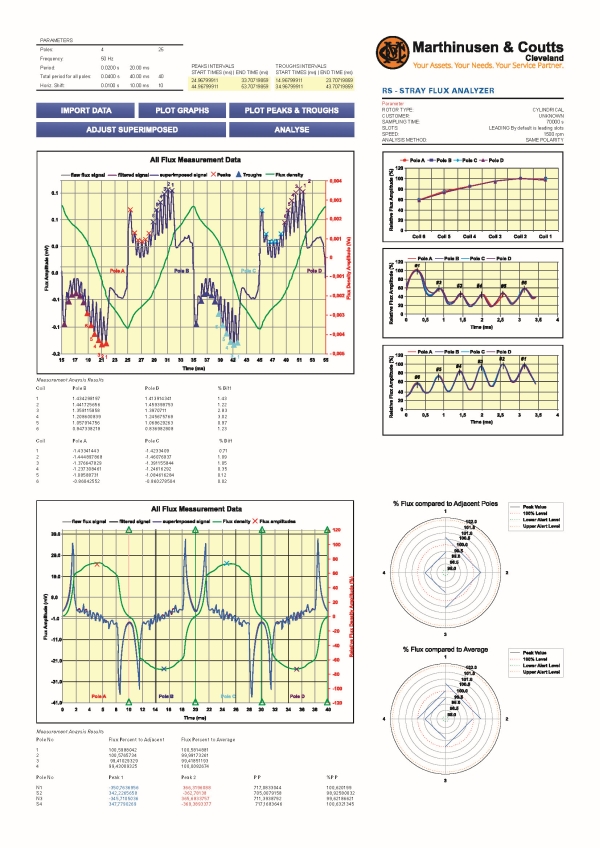
Technical Challenges and Breakthroughs
Developing these tools faced its challenges. Early efforts depended heavily on Excel and VBA to process large datasets—sometimes over 60,000 data points. However, this method proved too slow for practical use. The breakthrough occurred when Python was integrated into Excel, enabling much faster data processing. This technological advance, combined with smart use of AI resources and quick prototyping, allowed the team to develop solutions in just weeks—a process that could take others years.
Stray Flux Analyser: How It Works and Why It Matters
The Stray Flux Analyser examines sampled data from the voltage output of an air-core coil, usually installed in the air gap of a synchronous machine. By analysing this data, it can identify shorter turns in the rotor winding with remarkable accuracy. This capability is vital for early detection of faults that, if left unchecked, could lead to expensive repairs or unexpected outages. The analyser allows remote, automated analysis, reducing turnaround times from hours to minutes and enabling even technicians with minimal training to collect data for expert review.
Salient Pole Rotor Simulations: Expanding the Scope
While the stray flux technique has long been established for cylindrical rotor machines, salient pole rotors—common in hydroelectric generators—pose unique challenges due to their coil configurations. M&C's new simulation tool adapts analysis methods for salient-pole machines, making effective fault detection accessible across a broader range of equipment. This development is significant, given the prevalence of salient-pole machines in the industry and the historical difficulty in diagnosing them accurately.
Customer-Centric Innovation and Industry Impact
One of the key advantages of M&C's new tools is their capacity to deliver results quickly and remotely. Customers can record waveform data using affordable digital oscilloscopes and send it to M&C for nearly instant analysis. This removes the need for costly on-site technician visits and expensive proprietary analysers, resulting in significant savings in both time and money. Additionally, the rapid turnaround enhances M&C's credibility with clients, positioning the company as a reliable partner for swift troubleshooting and maintenance planning.
Teamwork and Recognition
The development of these tools was a collaborative effort, with significant contributions from lead designer Blondy Phoshoko. The innovation was achieved entirely in-house, further emphasising the team's technical prowess and dedication to continuous improvement.
Looking Ahead
M&C’s new diagnostic tools are already transforming maintenance practices and operational efficiency across the sector. By reducing analysis times and enabling proactive fault detection, these solutions help operators make better-informed decisions, extend machine life, and minimise unplanned outages. As the industry continues to evolve, M&C remains at the forefront, leveraging technical expertise and customer feedback to deliver tools that genuinely meet the needs of the modern power sector.