
ACTOM Kenya is making significant strides in the region’s energy sector, recently embarking on its first major high voltage and substation automation project - a move that signals both a milestone for the business and a turning point for the local industry.
In an exclusive interview, Eng. Kelvin Agengo, CEO of ACTOM Kenya, shared insights on the business evolution, challenges, and vision for the future.
Breaking Ground in High Voltage Equipment
Traditionally recognised for its low-voltage business, ACTOM Kenya is now venturing into high-voltage territory with the Galana-Kulalu Irrigation Scheme project. “This project is important for us because it’s our very first one in that [high voltage] space,” Eng. Agengo explained. ACTOM Kenya’s roots trace back to Power Techniques - Technics, later acquired by Schneider Electric and then ACTOM, but always within the low voltage domain. Now, the business is bringing the full ACTOM portfolio to Kenya, marking a strategic expansion.
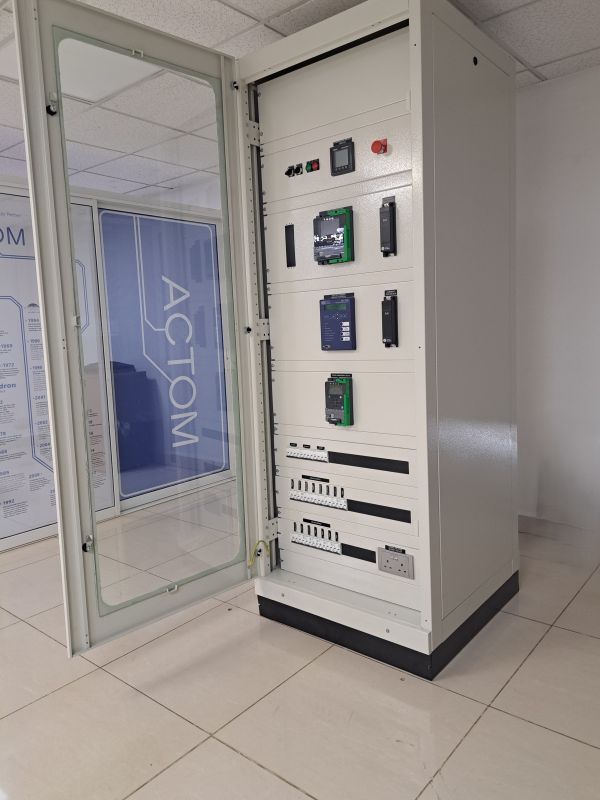
The Galana-Kulalu project covers approximately 350,000 acres on the Kenyan coast and requires a robust power infrastructure. ACTOM Kenya is responsible for the 66kV to 33kV substation, supplying high-voltage equipment such as breakers, disconnectors, CTs, VTs, control and relay panels (CRPs), and substation automation systems. While the control and relay panels and automation systems are designed and assembled locally, high-voltage equipment is sourced from ACTOM’s Johannesburg division.
Building Local Capacity and Overcoming Challenges
Stepping into high voltage and automation required ACTOM Kenya to build new technical capacity.
“The factory that ACTOM bought did not do CRPs before, so we had to start with training and capacity building,” said Eng. Agengo.
ACTOM Kenya worked closely with ACTOM Protection & Control and global technology partners, including Schneider Electric, to train its engineering teams. This included specialised certification programmes covering protection relays and substation automation technologies.
Market penetration was another hurdle. As Eng. Agengo noted, “Nobody knows that you can do this in Kenya. So how do you convince someone that you can actually do it?” ACTOM Kenya positioned itself as a local solutions provider, emphasising its unique in-region expertise and capabilities.
Ensuring Safety, Reliability, and Standards Compliance
For ACTOM Kenya, the safety and reliability of CRPs are paramount. The equipment is installed indoors in carefully controlled environments to mitigate risks from temperature, dust, and humidity. “Clean power” is ensured by a regulated, UPS-backed supply. On the automation side, ACTOM Kenya adheres to international ISO and IEC standards and relies on globally recognised OEMs such as Schneider Electric and Siemens for relay compatibility and interoperability.
Substation Automation and Remote Monitoring
At the heart of modern substation automation is the SCADA (Supervisory Control and Data Acquisition) system. “SCADA is the operating system for a substation,” said Eng. Agengo. These systems, provided by OEMs such as Schneider, ABB, and Siemens, enable remote monitoring and diagnostics, greatly enhancing operational efficiency. ACTOM Kenya’s teams are trained across multiple platforms, ensuring flexibility and adaptability in project execution.
Project Execution and After-Sales Support
Each project is managed end-to-end by a dedicated project manager, with processes aligned strictly with ISO standards and the businesses Integrated Management System (IMS). “We have a standardised, well-monitored process… backed by IMS,” Eng. Agengo emphasised. Training for client operators is an integral part of every project handover, covering SCADA, relay operation, troubleshooting, calibration, and reporting. Some clients also opt for ongoing service contracts for continued support.
Trends and Outlook in the East African Market
Kenya’s installed power generation capacity stands at around 3.8GW—much lower than South Africa’s—but is projected to grow significantly over the next two years as the country accelerates investment in renewable energy and infrastructure.
“The trend is the same in Uganda, Tanzania, and Ethiopia,” Eng. Agengo observed a surge in substation development and automation opportunities across the region. He also highlighted a shift away from lower-quality Chinese imports toward higher standards and local solutions.
Innovation and the Road Ahead
Looking ahead, ACTOM Kenya’s strategy is centred on localisation, with the transfer of intellectual property and manufacturing know-how from South Africa to Kenya.
“The vision is really to localise as much of that as we can,” Agengo said. True innovation, he argued, goes beyond new products to include new processes and approaches—especially in after-sales support, which will be critical as substations proliferate across the country.
As ACTOM Kenya continues to expand its capabilities in high voltage and substation automation, the business is poised to play a pivotal role in powering the next chapter of East Africa’s development.